CAC Episode 7: How to Restore Degraded Ecosystems?
CompletedOverview
Across much of the world, the land is losing its capacity to sustain life. Up to 40% of the world’s land is already degraded, affecting roughly 3.2 billion people and threatening countless species.[1] The United Nations Convention to Combat Desertification’s (UNCCD) World Drought Atlas, finds that drought, driven by climate change, along with mismanagement of water and land, has grown almost a third since 2000.[2]
Line space
As land dries, its soils change with it. The Food and Agriculture Organization of the United Nations’ (FAO) Global Status of Salt-Affected Soils, the first global assessment of its kind in half a century, found that close to 1.4 billion hectares, more than a tenth of the world's land, are already affected by salinity, with a further billion hectares at risk.[3]
Line space
Reversing this decline calls for more than technical fixes. The UNCCD’s Global Land Outlook Thematic Report on Rangelands and Pastoralism, 2024, emphasises that lasting recovery depends on sustainable land management and inclusive land governance.[4] Restoring 15% of converted land while halting further conversion could prevent as much as 60% of expected species extinctions, and every dollar invested can return up to thirty in ecosystem services.[5]
Line space
Aligned with this year’s UNCCD COP 17 and Convention on Biological Diversity (CBD) COP 17, GEAF is organising the seventh episode of its Climate Action Conversations series on the theme “How to Restore Degraded Ecosystems?”. The webinar will bring together experts to examine the drivers of ecosystem degradation and responses needed to restore them.
Line space
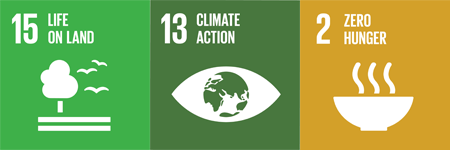
Anchored in the 2030 Agenda, the webinar contributes directly to
Line space
Webinar Objectives
As part of its commitment to environmental protection, GEAF is organizing the seventh episode of its Climate Action Conversation Series on the theme “How to Restore Degraded Ecosystems”. The initiative aims to:

Provide information on the state of the world's degraded ecosystems and the drivers behind their decline, including drought, soil degradation and salinity, and unsustainable land use, and explain what ecosystem restoration involves in practice.

Foster dialogue between experts, policymakers, environmental actors and practitioners on the technical, financial and governance challenges of restoring degraded land and ecosystems at scale.

Facilitate knowledge exchange on practical restoration approaches, sustainable land management, inclusive land governance and innovative financing, and on the links between land restoration, biodiversity and climate resilience.
Line space
Watch the full webinar recording and revisit the key discussions below
Insights and Impact
The discussion brought together diverse perspectives, on the emerging concept of ecosystem restoration and its implications for climate resilience, and sustainable development. Throughout the session, speakers highlighted the interconnected challenges of environmental justice, adaptive governance, and transboundary cooperation.
Resources
To extend the value of the discussion beyond the webinar, GEAF has developed a companion booklet that captures the key insights, recommendations, and perspectives shared by the speakers. Whether you attended the webinar or are exploring the topic for the first time, the booklet serves as a valuable resource for students, practitioners, policymakers, researchers, and all those interested in advancing climate resilience.

Speakers

Alfredina Dos Santos
Keynote Speaker | GEAF Ambassador Cohort ' 26

Eduardo Mansur
Senior Environment Advisor, former Director of Climate and Environment at UN FAO, former General Manager of Forests of Saudi Arabia

Mariam Gibson Bwire
Wildlife Conservation Officer, Mbulu District | GEAF Ambassador Cohort '26
Tsiaterimila Prince
Founder and President of FTVA (Youth4Adaptation) | GEAF Ambassador (Cohort ‘25)

Dr. Terry Sunderland
Professor - Department of Forest and Conservation Sciences at the University of British Columbia (UBC)